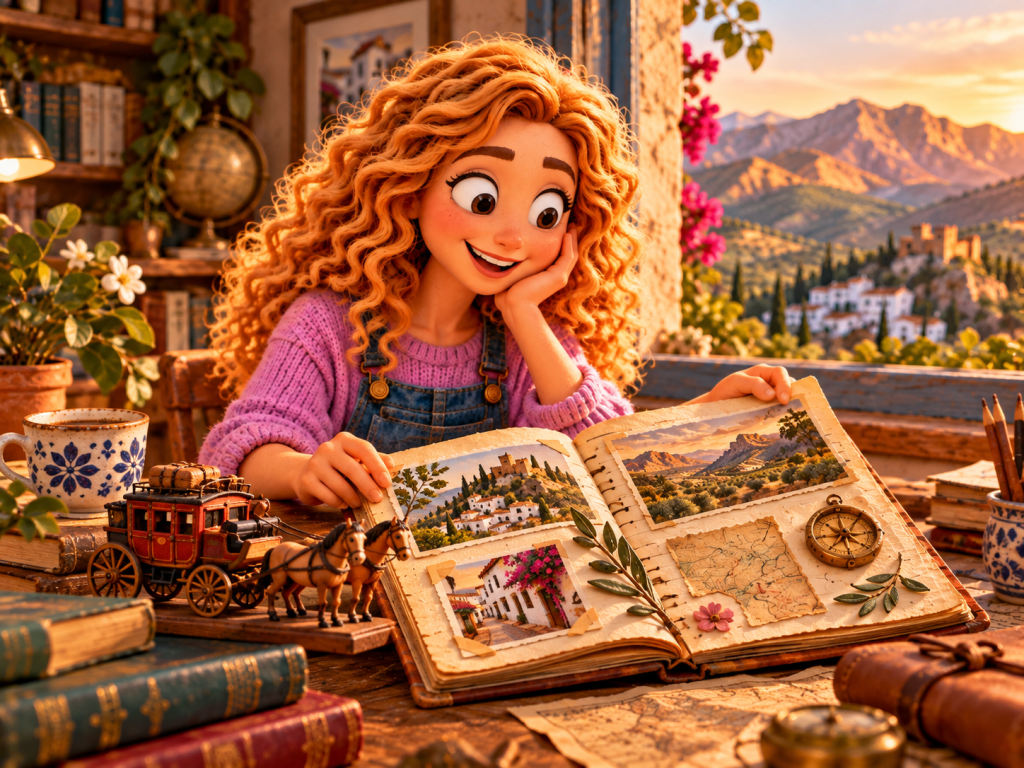
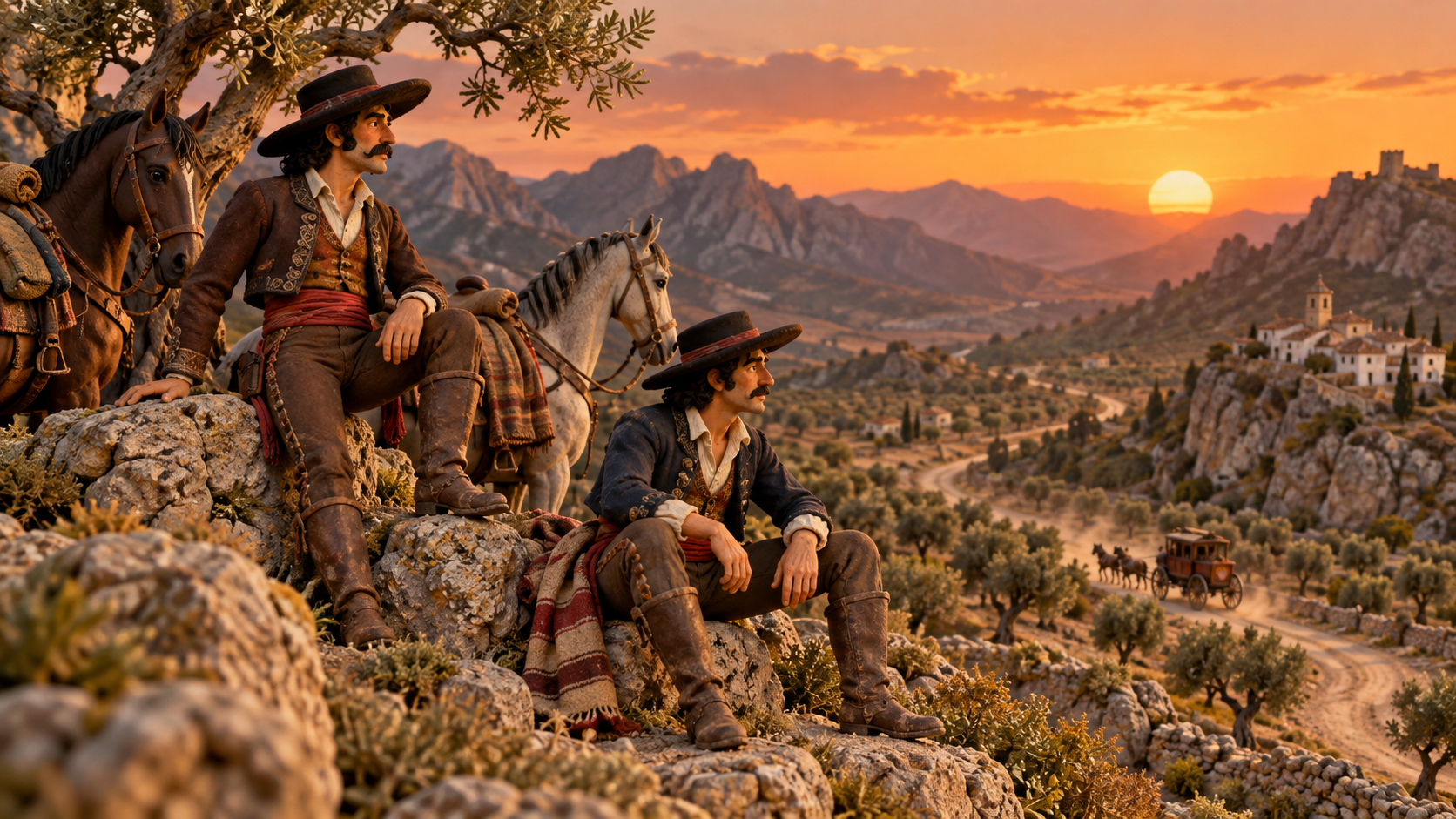
A mountain road, a passing carriage and a bandolero waiting in the hills: it is an image that has travelled through paintings, books and television. But how much of it belongs to history, and how much to the stories people wanted to tell about Spain?
Afternoons with my grandfather
I still fondly remember those wonderful afternoons with my grandfather watching Curro Jiménez. At the time, I did not know that behind those television adventures lay a real history of Spanish banditry — or that Sancho Gracia’s character was inspired by a man called Andrés López.
Known as el Barquero de Cantillana, Andrés López provided an inspiration for the series. That does not make the programme a faithful biography: it combines historical inspiration with adventure, humour and the figure of a popular hero.
The bandolero: history and legend
Banditry was not just an Andalusian phenomenon, but the mountain landscapes of Andalucía became especially prominent in its popular image. Roads, isolated terrain and the social circumstances of different periods helped shape both the phenomenon and its stories.
Bandoleros could rob travellers, take part in smuggling or commit other crimes. Tales sometimes transformed them into generous outlaws who challenged powerful people and helped the poor. Such stories are part of the legend; they should not be treated as a description of every bandit.
Poverty and inequality belong in the historical discussion, but they do not explain every individual’s life. Nor can we assume that robberies were harmless simply because a later book or television series presented them as an adventure.
Why Romantic travellers were fascinated
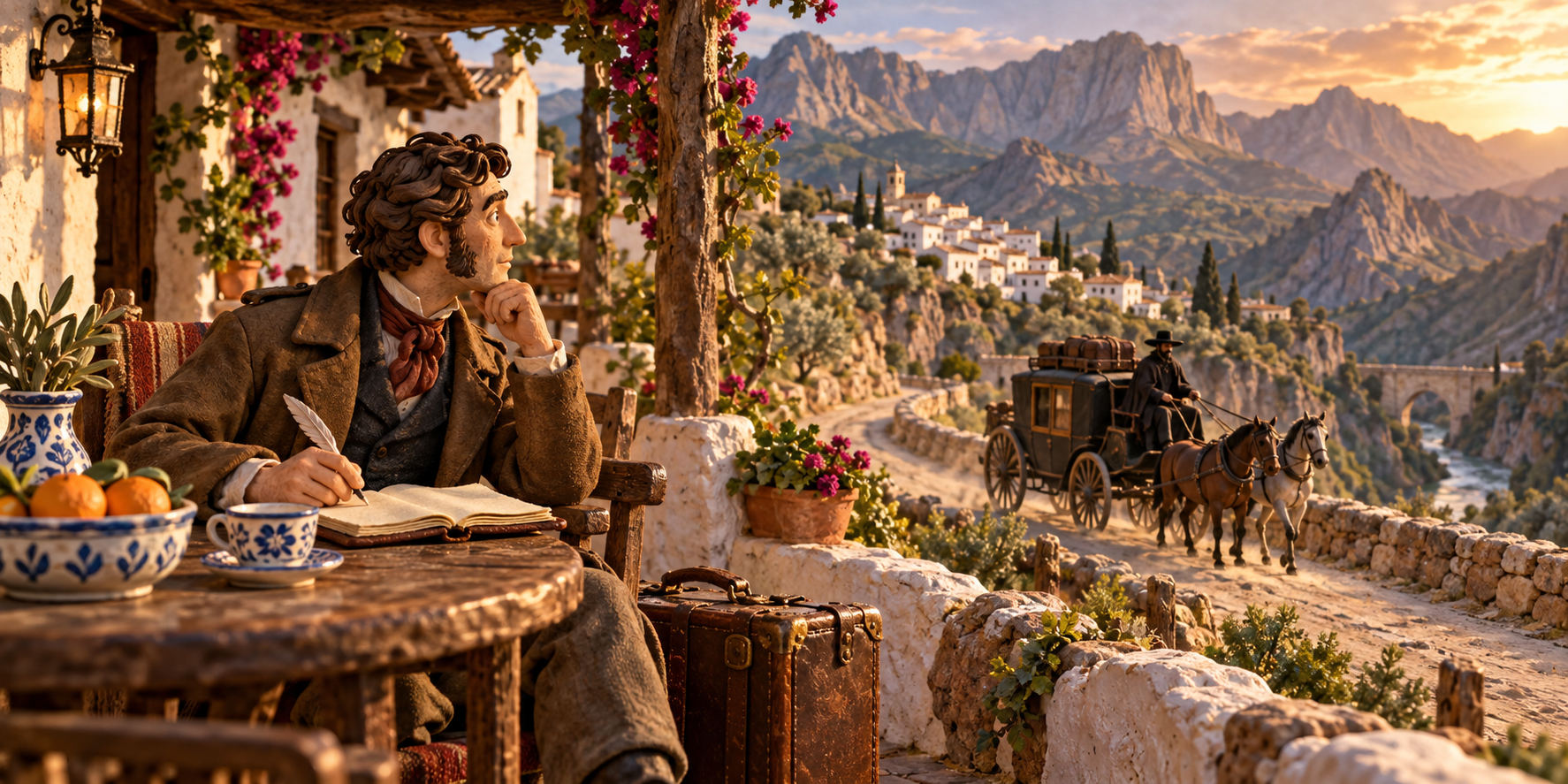
In the nineteenth century, Spain became an important destination for Romantic travellers. Writers such as Théophile Gautier and Richard Ford described its landscapes, towns and people through their own expectations and impressions.
The Biblioteca Nacional de España explains that this kind of journey became an intensely personal experience. Travellers sought nature, emotion and places away from modern city life — often arriving with an already stereotyped idea of Spain.
Bandoleros fitted neatly into that imagined world. The Instituto Cervantes shows how travel writers used them to add suspense and a novel-like quality to their accounts, sometimes exaggerating their appearance and adventures.
There was both fear and fascination. It would be too sweeping to say that every traveller wanted to be robbed, or that a visit was incomplete without a bandit encounter. What we can see is how the possibility of danger became part of the story told to readers.
A painting worth looking at
Manuel Barrón’s Vista del puerto de Miravete, camino antiguo de Madrid (1869), held by the Museo Carmen Thyssen Málaga, brings together a dramatic mountain landscape and an attack on a stagecoach. Its setting is in Extremadura, a reminder that these stories extend beyond Andalucía.
The museum’s commentary helps us read the painting as a Romantic representation, with its own narrative choices. You can explore the work and its details on the museum’s collection page.
Spanish words for the journey
| Español | English |
|---|---|
| el bandolero | bandit / outlaw |
| la sierra | mountain range |
| el camino | road / path |
| la diligencia | stagecoach |
| el viajero / la viajera | traveller |
| el contrabando | smuggling |
| el relato de viaje | travel account |
| la leyenda | legend |
La historia y la leyenda se mezclan.
History and legend become intertwined.
El viajero escribió sus impresiones.
The traveller wrote down his impressions.
España me robó el corazón.
Spain stole my heart.
The stories we carry with us
For me, the subject still begins with those afternoons beside my grandfather. Learning the history adds another layer to the memory: we can enjoy a story and also ask who told it, what they imagined, and what the evidence shows.
And to borrow the playful ending of my original article: perhaps the most welcome thing Spain can steal is your heart. ♥
Sources and further reading
RTVE: Curro Jiménez and its historical inspiration · RTVE: the television hero and the real Andrés López.
Biblioteca Nacional de España: travel writing in the nineteenth century · Instituto Cervantes: bandoleros in foreign travel accounts.
Museo Carmen Thyssen Málaga: Manuel Barrón’s Miravete painting.